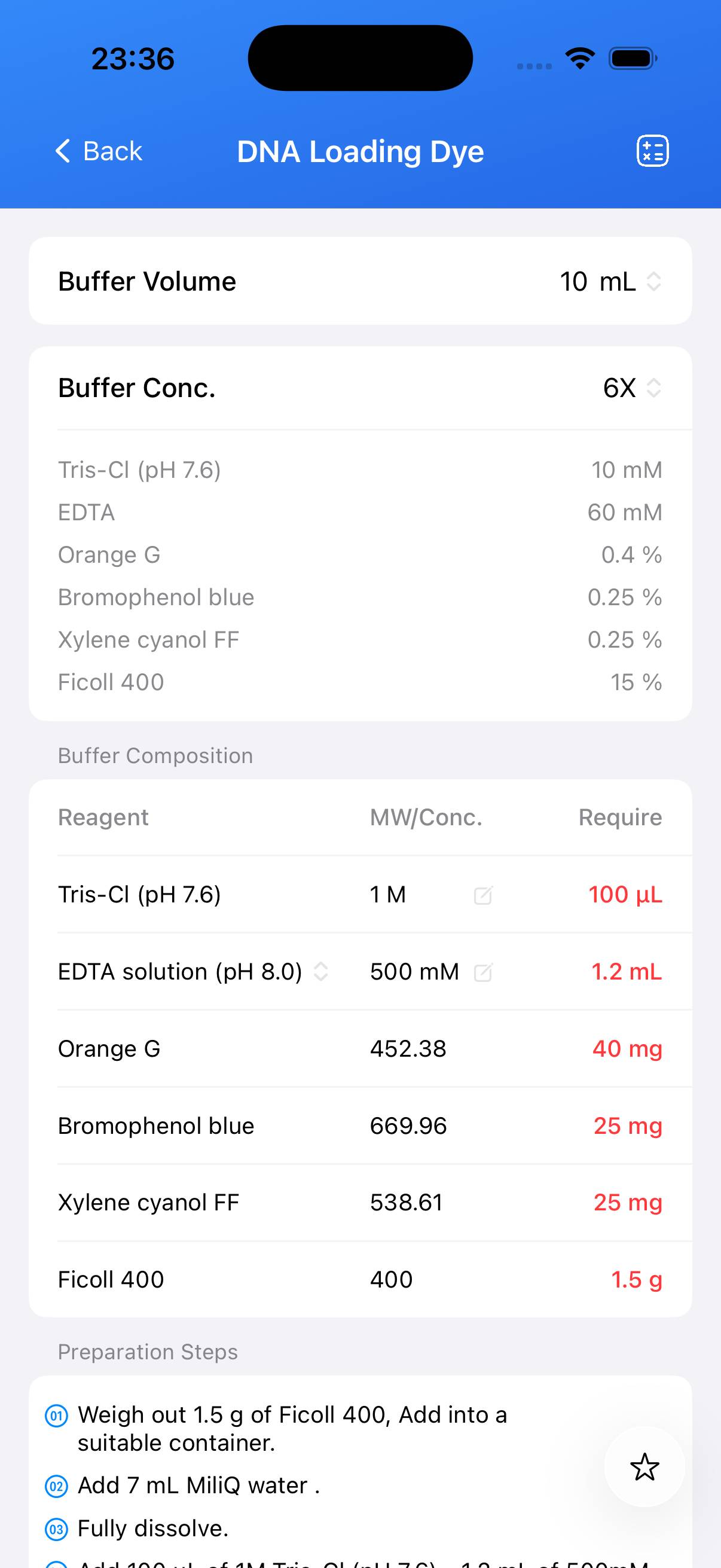
Preparation DNA Loading Dye
This guide describes the preparation of DNA Loading Dye at a defined molarity for laboratory use.
The following content was generated by AI and has not been strictly verified; it may contain inaccuracies. All information in the BioCalculator App has been manually curated and carefully validated. You can download the App to view it.
DNA Loading Dye is used for tracking DNA migration in agarose or polyacrylamide gels.
6X DNA Loading Dye – Composition
| Name | Formula | Concentration | CAS |
|---|---|---|---|
| Tris-Cl (pH 7.6) | C₄H₁₁NO₃ | 10 mM | 77-86-1 |
| EDTA | C₁₀H₁₆N₂O₈ | 60 mM | 60-00-4 |
| Orange G | C₁₆H₁₀N₂Na₂O₇S₂ | 0.4% (w/v) | 1936-15-8 |
| Bromophenol blue | C₁₉H₁₀Br₄O₅S | 0.25% (w/v) | 115-39-9 |
| Xylene cyanol FF | C₂₅H₂₇N₂NaO₆S₂ | 0.25% (w/v) | 2650-17-1 |
| Ficoll 400 | (C₁₂H₂₂O₁₁)n·(C₃H₅ClO)n | 15% (w/v) | 26873-85-8 |
Sterilization & Storage
- Sterilization: Not required.
- Storage: Aliquot in 1 mL tubes; 4 °C or −20 °C.
Tips
- There are many formulations for DNA loading dye; only one example is provided here.
- Before adding dyes (up to step 4), the solution may appear colorless to yellowish and turbid.
- When preparing small volumes (e.g., 10 mL), ensure no residual solution remains on the tube walls or cap before adjusting volume.
- Use an appropriate container and complete the procedure in a single container if possible, as the solution is viscous and hard to pipette.
- Dye concentrations can be adjusted: bromophenol blue and xylene cyanol FF 0.03%–0.50% (w/v); Orange G 0.15%–0.50% (w/v).
- High dye concentrations improve visual contrast but may obscure comigrating DNA bands; use lower concentrations when co-migrating DNA fragments are expected.
- Ficoll 400 may be replaced with 60% (v/v) glycerol or 40% (w/v) sucrose; sucrose solutions should be frozen.
- Ficoll-containing loading dyes help DNA sink into agarose more effectively but are more costly.
- Three-color loading dyes better indicate DNA fragment resolution but are more expensive.
Preview