Ligation Molar Ratio Calculator
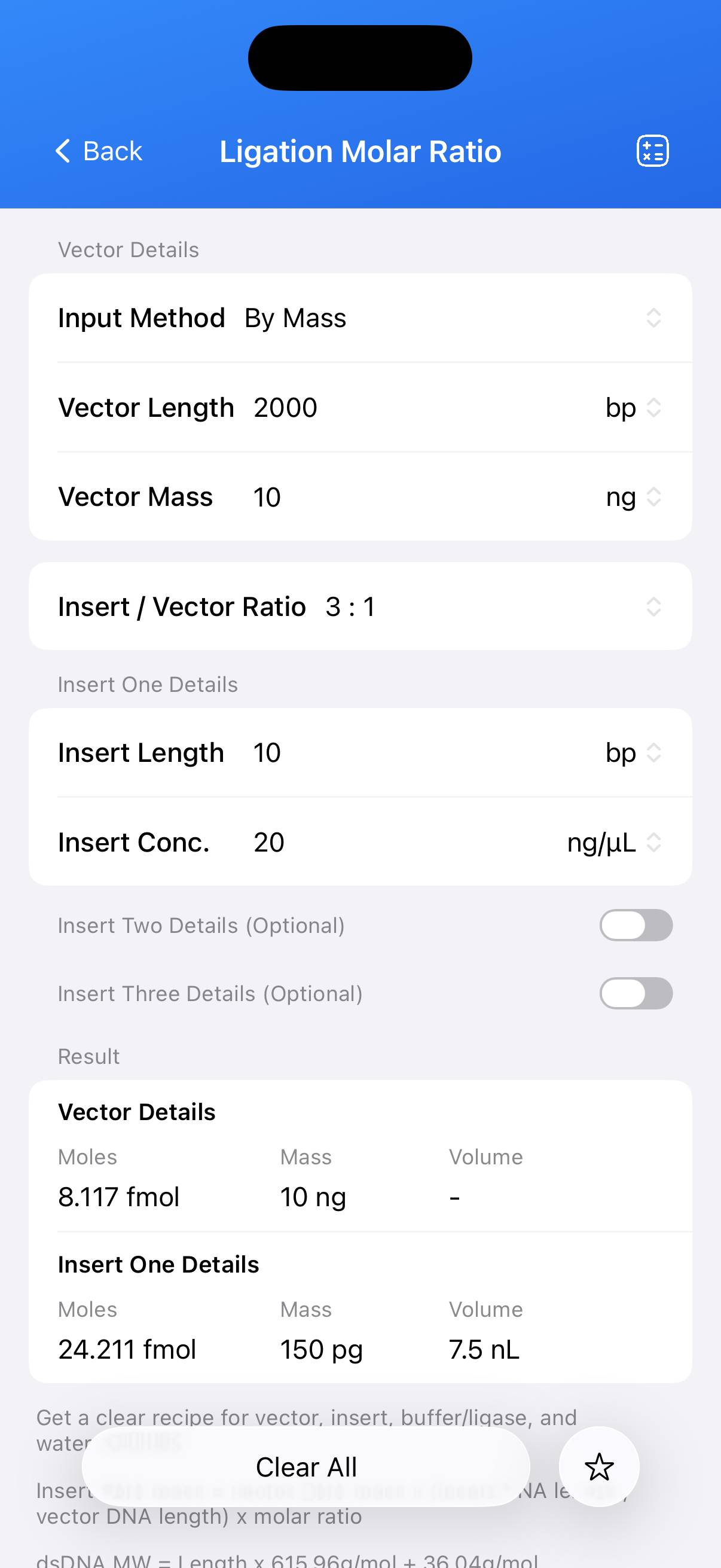
Designed for molecular cloning workflows, this calculator determines the exact amount of insert DNA needed based on your vector amount and desired molar ratio.
Insert Amount Calculator for Molecular Cloning
Designed for molecular cloning workflows, this calculator determines the exact amount of insert DNA required based on the amount of vector DNA and a user-defined insert-to-vector molar ratio. It simplifies ligation setup by providing a complete and precise reaction recipe.
Key Features
- Multiple Insert Support:
Plan ligation reactions involving up to three different insert fragments simultaneously, enabling standard cloning as well as multi-fragment assemblies. - Flexible Vector Input:
Specify the vector amount directly by mass (ng), or calculate it from a stock solution using concentration (ng/µL, fmol/µL, or nM) and volume. - Flexible Insert Input:
Insert stock concentrations can be entered in ng/µL, fmol/µL, or nM, allowing seamless integration with different quantification methods. - Molar Ratio–Based Calculation:
Enter the desired Insert:Vector molar ratio (e.g., 3:1). The calculator determines the required amount of each insert in both picomoles (pmol) and nanograms (ng). - Precise Volume Calculation:
Calculates the exact volume (µL) of each insert stock solution needed for the ligation reaction. - Complete Reaction Volume Planning:
Input the desired total ligation volume and the volume occupied by buffer and ligase. The calculator automatically determines the amount of water required to complete the reaction. - Customizable Molecular Weight per Base Pair:
Optionally override the standard average molecular weight per base pair to match specific experimental assumptions.
Why Use This Tool?
Manual ligation calculations are time-consuming and prone to error, especially when working with multiple inserts or different concentration units. This calculator eliminates tedious arithmetic, reduces setup mistakes, and provides a clear, step-by-step recipe for vector, insert(s), buffer/ligase, and water volumes.
Whether you are performing routine cloning or complex multi-fragment ligations, this tool helps streamline experimental planning and improves reproducibility in molecular cloning workflows.