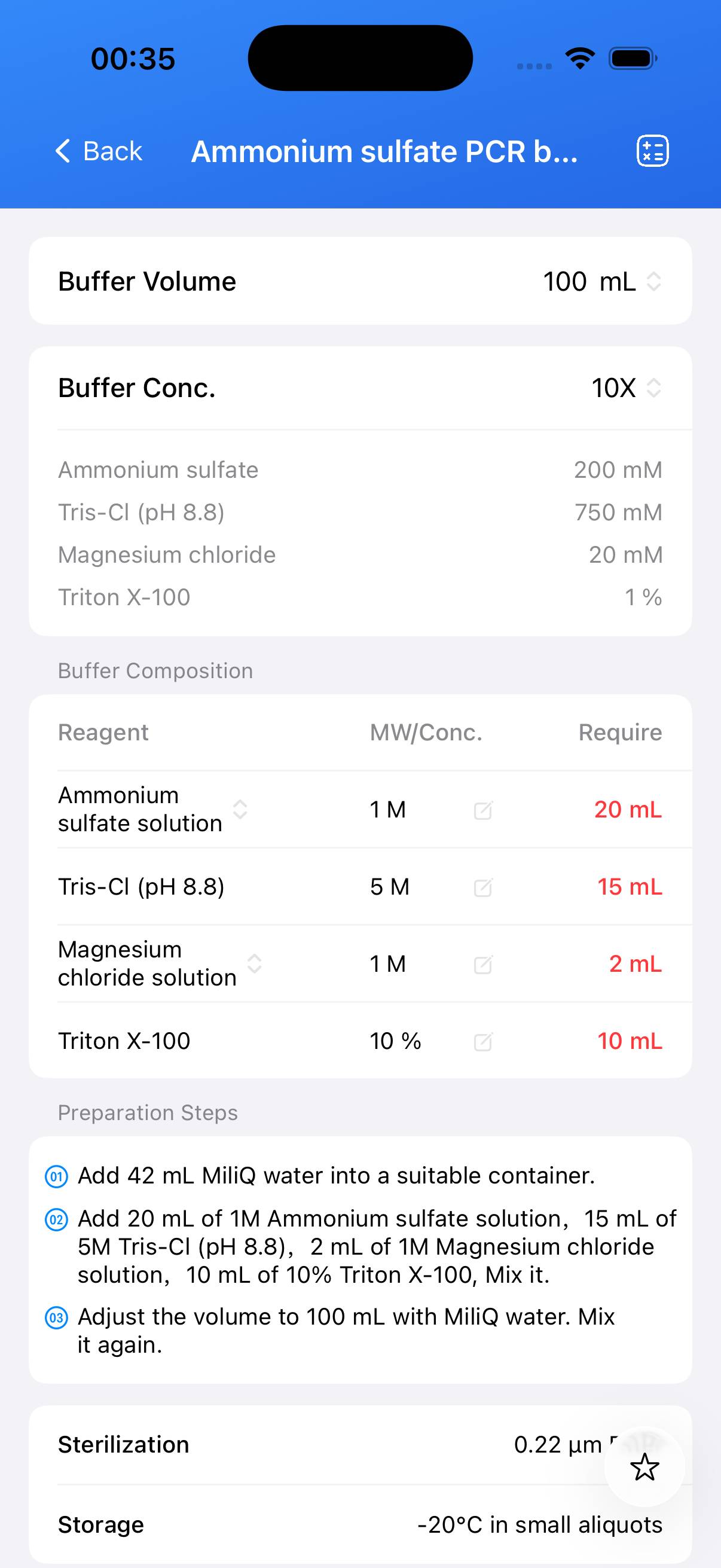
Preparation Ammonium sulfate PCR Buffer
This guide describes the preparation of Ammonium sulfate PCR Buffer at a defined molarity for laboratory use.
The following content was generated by AI and has not been strictly verified; it may contain inaccuracies. All information in the BioCalculator App has been manually curated and carefully validated. You can download the App to view it.
Ammonium sulfate PCR Buffer is commonly used to enhance primer specificity and optimize DNA polymerase activity.
Ammonium Sulfate PCR Buffer – Composition
| Name | Formula | Concentration | CAS |
|---|---|---|---|
| Ammonium sulfate | (NH₄)₂SO₄ | 20 mM | 7783-20-2 |
| Tris-Cl (pH 8.8) | C₄H₁₁NO₃ | 75 mM | 77-86-1 |
| Magnesium chloride | MgCl₂ | 2 mM | 7791-18-6 |
| Triton X-100 | C₃₄H₆₂O₁₁ | 0.1% (w/v) | 9002-93-1 |
Sterilization & Storage
- Sterilization: 0.22 μm filtration.
- Storage: Aliquot and store at −20 °C.
Tips
- Buffer pH is usually 8.0–9.5, adjusted by Tris-Cl.
- Triton X-100 is highly viscous; use low-concentration stock or substitute with Tween 20.
- When ammonium sulfate is used, MgCl₂ is typically higher (2.0 ± 0.5 mM).
- NH₄⁺ and Mg²⁺ exhibit antagonistic effects; buffers with ammonium sulfate show higher primer specificity across Mg²⁺ ranges.
- Ammonium ions destabilize mismatched primer–template hydrogen bonds, enhancing reaction specificity.
- Optimal PCR buffer depends on DNA polymerase type; follow supplier recommendations.
- Direct use of anhydrous MgCl₂ is exothermic; add in small portions to partial solvent volume.
Preview