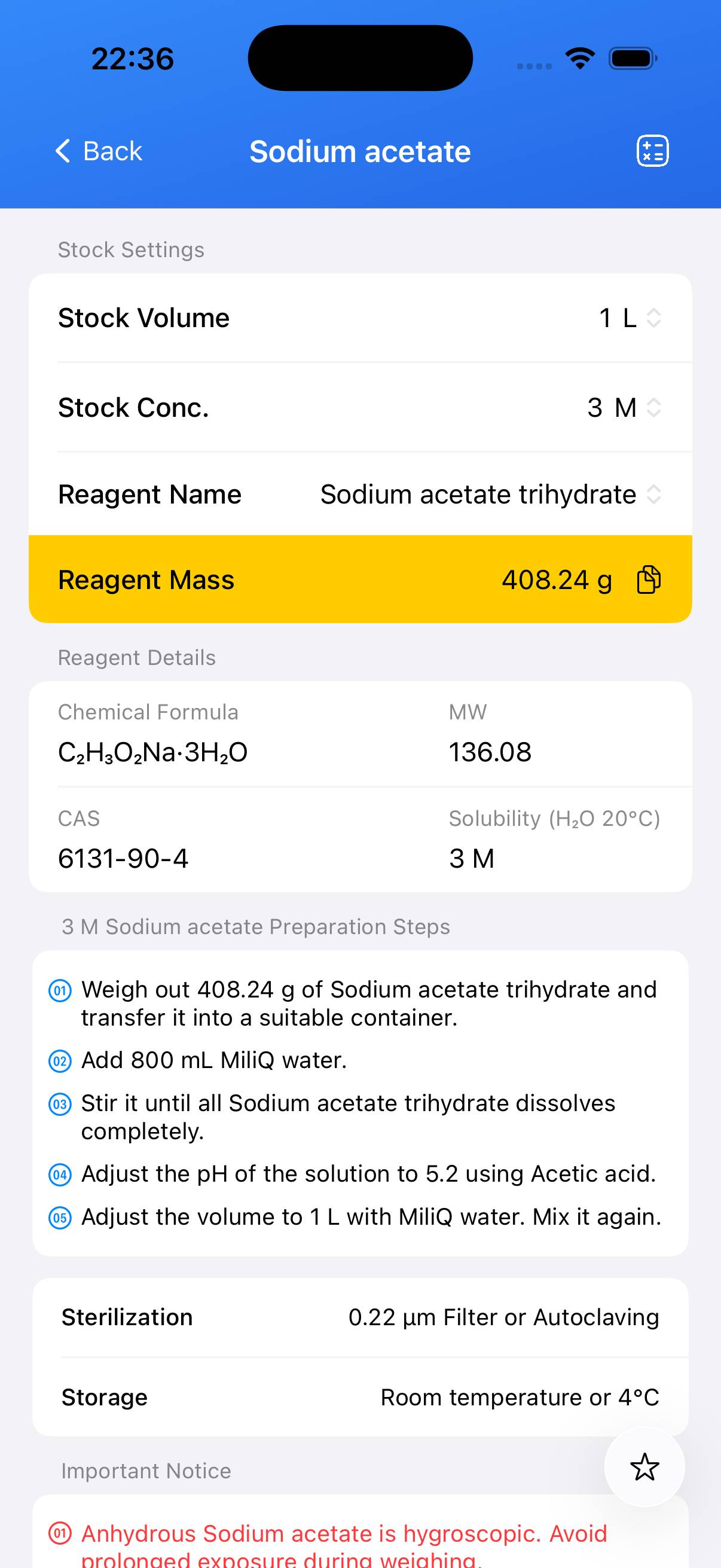
Sodium acetate Stock Solution
This guide describes the preparation of Sodium acetate Stock Solution at a defined molarity for laboratory use.
The following content was generated by AI and has not been strictly verified; it may contain inaccuracies. All information in the BioCalculator App has been manually curated and carefully validated. You can download the App to view it.
Stock Solution Preparation Guide – 3 M Sodium Acetate (C₂H₃O₂Na) Buffer, pH 5.2
Sodium acetate is a sodium salt of acetic acid that dissolves readily in water. Both anhydrous and hydrated forms can be used to prepare a high‑concentration buffer. A 3 M sodium acetate buffer (pH 5.2) is commonly used in molecular biology for nucleic acid precipitation and other applications.
Objective
Preparation of 100 mL of 3 M sodium acetate buffer at pH 5.2.
Composition
- 3 M sodium acetate buffer (pH 5.2)
Required Materials
- Sodium acetate anhydrous or trihydrate
- Glacial acetic acid (for pH adjustment)
- Deionized or distilled water
- Analytical balance
- Beaker or conical flask
- Volumetric flask or graduated cylinder
- Stirring rod or magnetic stirrer
- pH meter or pH indicator
- Personal protective equipment (gloves, goggles, lab coat)
Procedure
- Step 1
Accurately weigh the appropriate amount of sodium acetate. To prepare 100 mL of 3 M buffer using **anhydrous sodium acetate (MW = 82.03)**, weigh **24.61 g**. If using the trihydrate form (MW = 136.08), weigh proportionally more (~40.82 g). - Step 2
Place the weighed solid into a beaker containing ~80 mL of deionized/distilled water and stir until completely dissolved. - Step 3
Adjust the pH to **5.2** by adding glacial acetic acid dropwise while stirring, and monitor with a calibrated pH meter at room temperature. - Step 4
Transfer the solution to a 100 mL volumetric flask, rinse the beaker into the flask with water, and add deionized water to reach the final volume of **100 mL**. Mix thoroughly. - Step 5 (Optional)
Sterilize by autoclaving or filter through a **0.22 µm** membrane if required for biological applications.
Note: Anhydrous sodium acetate is hygroscopic and can absorb water from air, making accurate weighing difficult; consider using trihydrate form for precision. Label the container with concentration, pH, and date. Store the buffer at room temperature.
Available Reagents
| Name | Molecular Formula | MW | CAS |
|---|---|---|---|
| Sodium acetate trihydrate | C₂H₃O₂Na·3H₂O | 136.08 | 6131‑90‑4 |
| Sodium acetate (anhydrous) | C₂H₃O₂Na | 82.03 | 127‑09‑3 |