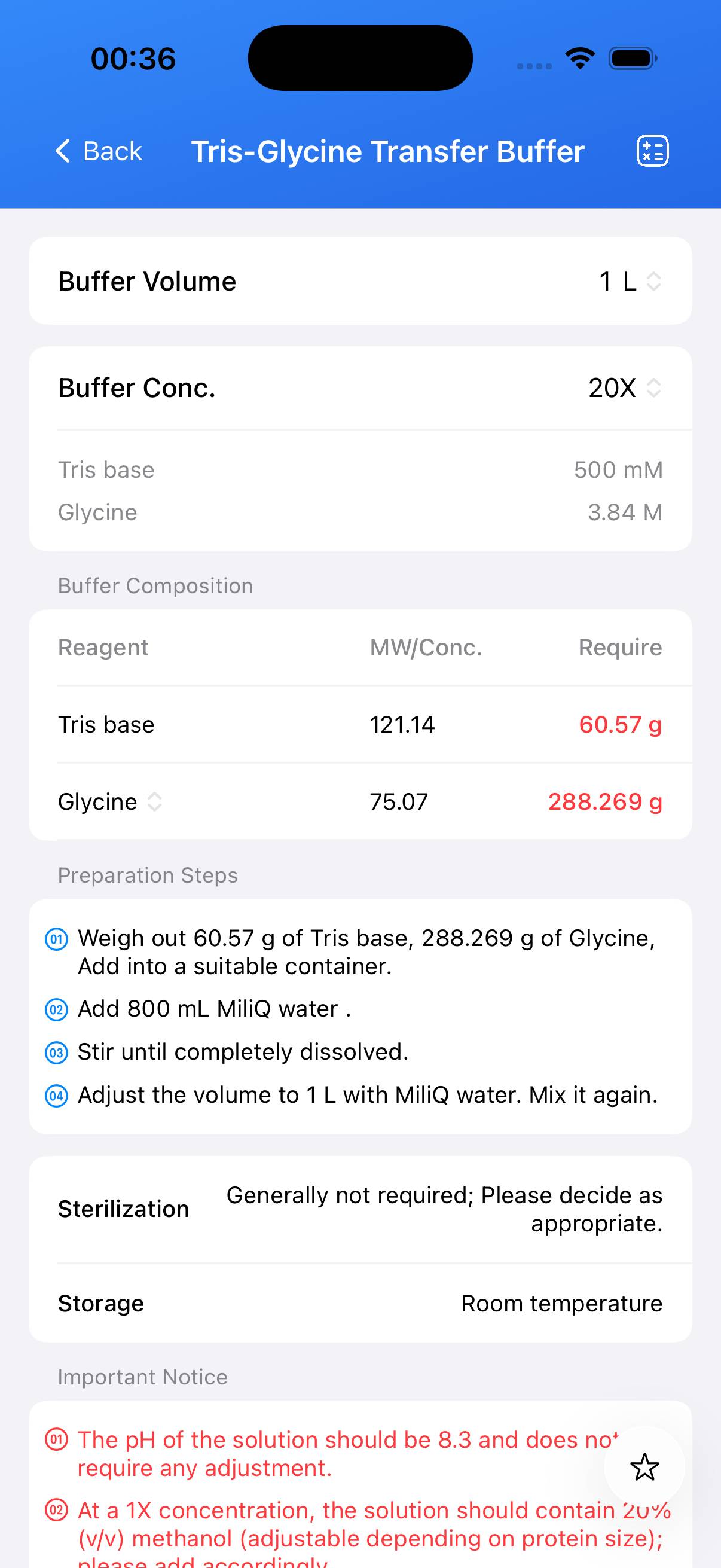
Preparation Tris-Glycine Transfer Buffer
This guide describes the preparation of Tris-Glycine Transfer Buffer at a defined molarity for laboratory use.
The following content was generated by AI and has not been strictly verified; it may contain inaccuracies. All information in the BioCalculator App has been manually curated and carefully validated. You can download the App to view it.
Tris-Glycine Transfer Buffer is commonly used for protein transfer in Western blotting.
Tris-Glycine Transfer Buffer – Composition
| Name | Formula | Concentration | CAS |
|---|---|---|---|
| Tris base | C₄H₁₁NO₃ | 25 mM | 77-86-1 |
| Glycine | NH₂CH₂COOH | 192 mM | 56-40-6 |
| Methanol | CH₃OH | 20% (v/v) | 67-56-1 |
Sterilization & Storage
- Sterilization: Usually not required, optional
- Storage: Room temperature
Tips
- The pH of the solution should be 8.3 and does not require any adjustment.
- At a 1X concentration, the solution should contain 20% (v/v) methanol (adjustable depending on protein size); please add accordingly.
- For large proteins, increase the amount of SDS (typical working concentration 0.025–0.1% w/v) and reduce methanol; for small proteins, do the opposite.
- Crystallization may occur when the 10X concentrate is stored at lower ambient temperatures. Warm in a 37°C water bath until fully dissolved before dilution and use.
Preview