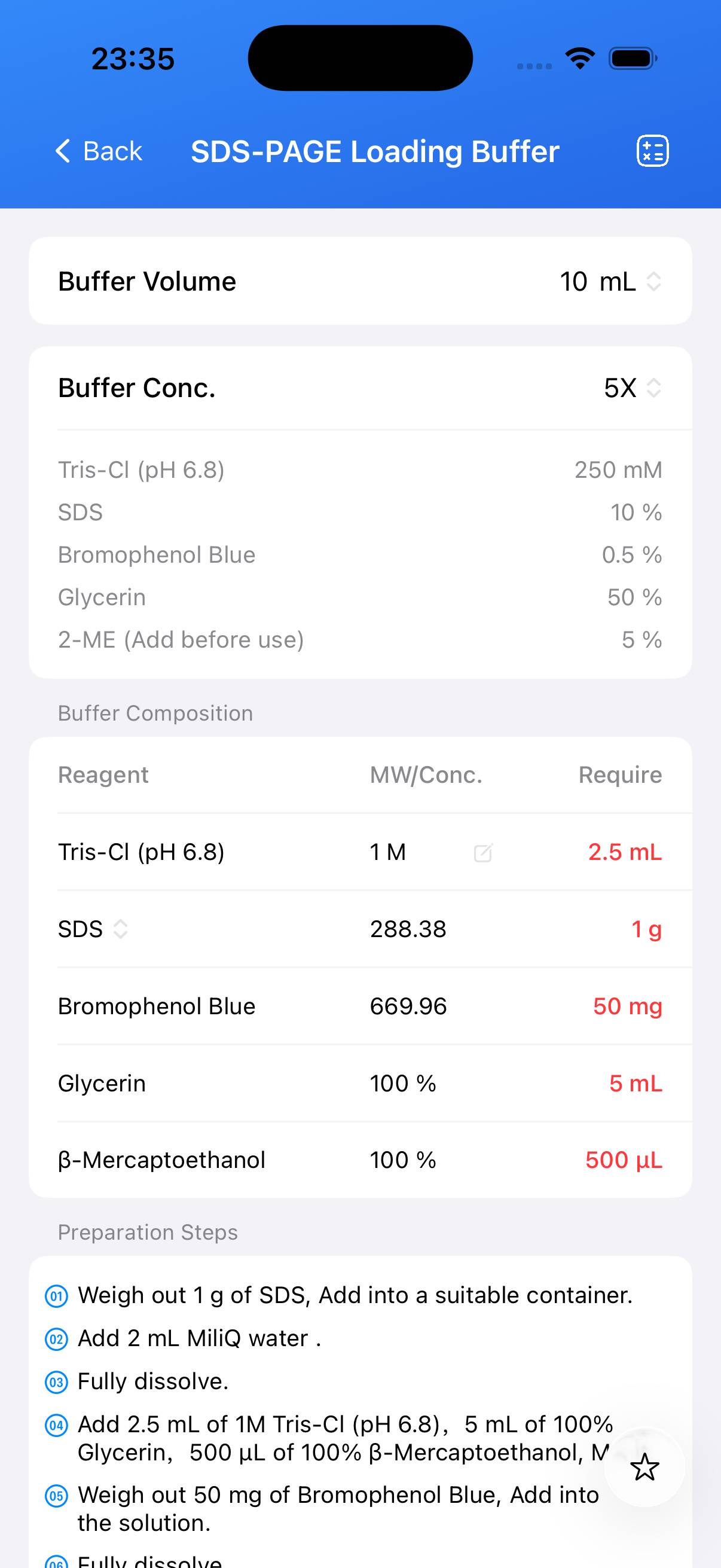
Preparation SDS-PAGE Loading Buffer
This guide describes the preparation of SDS-PAGE Loading Buffer at a defined molarity for laboratory use.
The following content was generated by AI and has not been strictly verified; it may contain inaccuracies. All information in the BioCalculator App has been manually curated and carefully validated. You can download the App to view it.
SDS-PAGE loading buffer (sample buffer) is used to prepare protein samples for denaturing polyacrylamide gel electrophoresis by providing denaturation, density, and tracking dye.
SDS-PAGE Loading Buffer – 1X Working Solution Composition
| Name | Formula | Concentration (1X) | CAS |
|---|---|---|---|
| Tris-Cl (pH 6.8) | C₄H₁₁NO₃ | 50 mM | 77-86-1 |
| SDS | C₁₂H₂₅O₄NaS | 2% (w/v) | 151-21-3 |
| Bromophenol Blue | C₁₉H₁₀Br₄O₅S | 0.1% (w/v) | 115-39-9 |
| Glycerin | C₃H₈O₃ | 10% (v/v) | 56-81-5 |
| β-Mercaptoethanol (Add before use) | C₂H₆OS | 1% (v/v) | 60-24-2 |
Applications of SDS-PAGE Loading Buffer
SDS-PAGE loading buffer is used to denature proteins, impart uniform negative charge, increase sample density for loading, and allow visual monitoring of electrophoresis progress during denaturing polyacrylamide gel electrophoresis.
Preparation Tips, Sterilization, and Storage
- The required amount of reducing agent can be added during preparation and stored at −20°C, but activity loss over time may cause ghost bands.
- For reducing SDS-PAGE, β-mercaptoethanol is recommended to be added before use to a final concentration of 1% (v/v). The buffer is typically stable for about one month after addition.
- β-Mercaptoethanol is toxic and has a strong odor; use appropriate protection.
- Alternative formulations may be used, such as replacing 1% (v/v) β-mercaptoethanol with 100 mM DTT.
- SDS may form flocculent precipitates at low temperatures; ensure complete dissolution before use.
- Sterilization: usually not required; choose as needed.
- Storage: room temperature; if reducing agent is pre-added, store aliquots at −20°C.