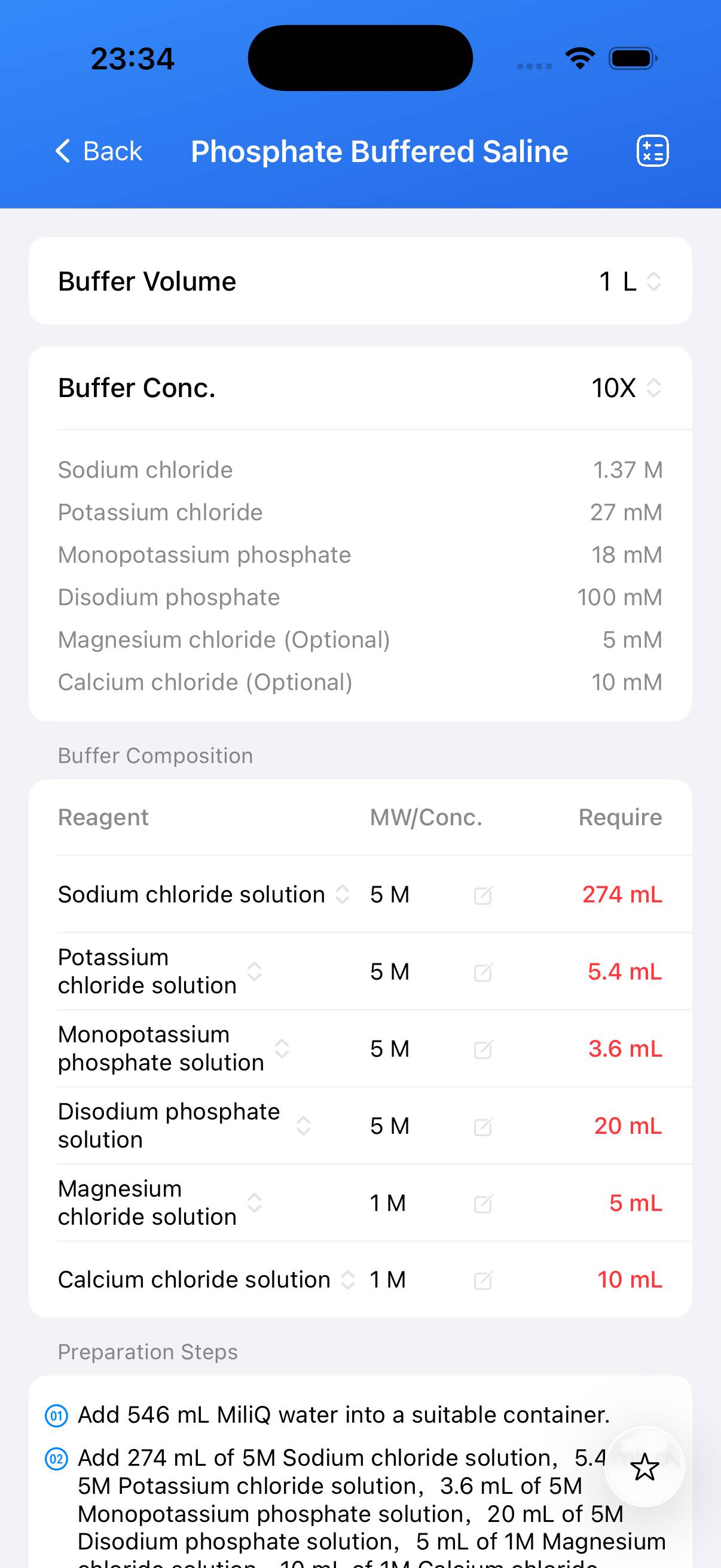
Preparation Phosphate Buffered Saline
This guide describes the preparation of Phosphate Buffered Saline at a defined molarity for laboratory use.
The following content was generated by AI and has not been strictly verified; it may contain inaccuracies. All information in the BioCalculator App has been manually curated and carefully validated. You can download the App to view it.
Phosphate Buffered Saline (PBS) is a widely used biological buffer in research laboratories, isotonic and compatible with most cells, with pH close to physiological conditions.
Phosphate Buffered Saline (PBS) – 1X Working Solution Composition
| Name | Formula | Concentration (1X) | CAS |
|---|---|---|---|
| Sodium chloride | NaCl | 137 mM | 7647‑14‑5 |
| Potassium chloride | KCl | 2.7 mM | 7447‑40‑7 |
| Monopotassium phosphate | KH₂PO₄ | 1.8 mM | 7778‑77‑0 |
| Disodium phosphate | Na₂HPO₄ | 10 mM | 7558‑79‑4 |
| Magnesium chloride (optional) | MgCl₂ | 0.5 mM | 7791‑18‑6 |
| Calcium chloride (optional) | CaCl₂ | 1 mM | 10043‑52‑4 |
Common Uses of PBS
PBS is widely used in molecular biology and cell culture because it is isotonic and non-toxic to most cells. Applications include washing cells or tissues, diluting biological samples, reagent preparation, container rinsing, immunoassays, and molecular biology workflows. PBS is also used to maintain osmotic balance in experiments.
Preparation Tips, Sterilization, and Storage
- The pH of 10X PBS solution is 6.8. When diluted to 1X, the pH becomes 7.4.
- After preparation with Milli-Q water, 1X PBS usually reaches pH 7.2–7.4 without adjustment.
- If strict pH control is required, measure and adjust pH after dilution.
- Storing concentrated PBS at 4°C may lead to salt precipitation. Shake well before use; discard if particles persist.
- Disodium phosphate is highly hygroscopic; avoid long exposure during weighing.
- Calcium chloride and magnesium chloride are optional; add according to experimental needs.
- Anhydrous CaCl₂ and MgCl₂ generate heat upon dissolution; handle with care.
- Sterilization: 0.22 μm filtration or autoclaving.
- Storage: room temperature or 4°C.